
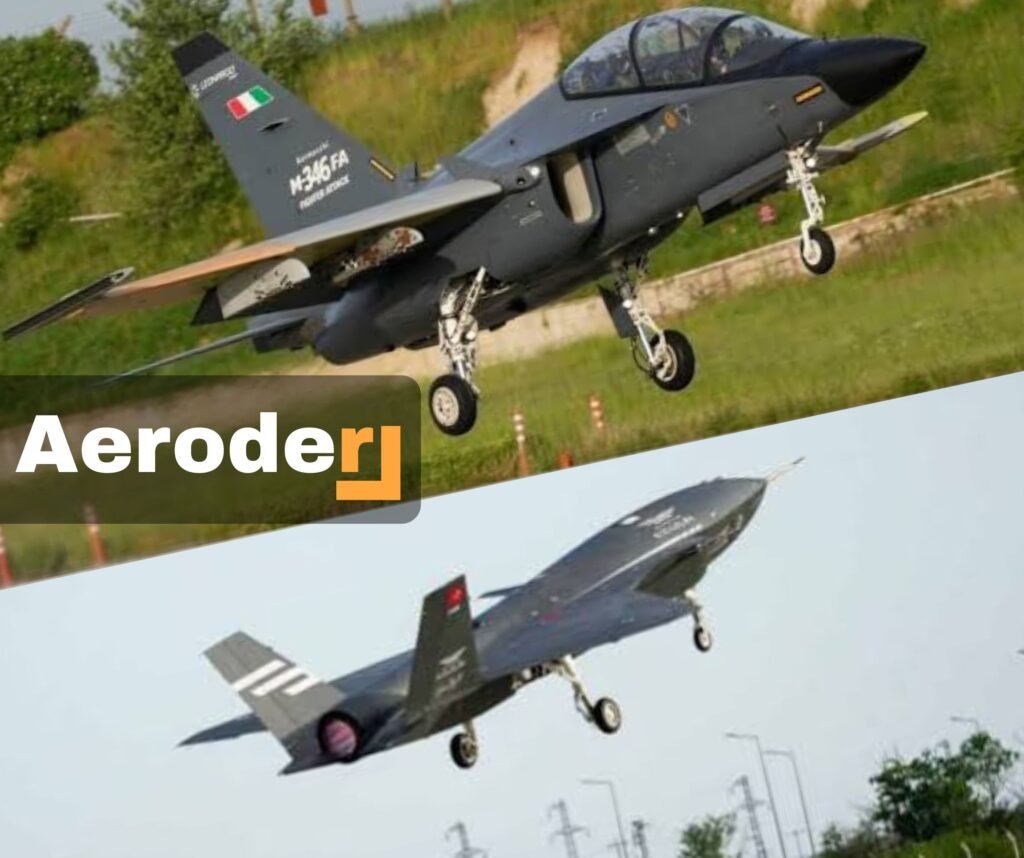
In a massive leap forward for the development of Crewed/UnCrewed Teaming (CUC-T) and autonomous swarm tactics, aerospace giants Leonardo and Baykar have successfully completed the first phase of live testing activities for the K-SWARM programme.
The landmark flight campaign, which took place in May 2026 at one of Baykar’s flight and test centres in Çorlu, Türkiye, successfully validated the interoperability and coordinated deployment of crewed fighter trainers alongside high-performance autonomous uncrewed combat platforms.
As collaborative combat teaming increasingly becomes the defining enabler for next-generation combat air systems, the transition of the K-SWARM programme from digital simulation to live operations marks a critical technological, operational, and industrial shift for modern military aviation.
The flight trials moved beyond simulated environments by executing complex joint autonomous formation flights. Following an autonomous taxi and take-off, the KIZILELMA dynamically rejoined the M-346 Fighter Attack using Smart Fleet Autonomy algorithms developed by Baykar’s Hardware-in-the-Loop (HIL) Laboratory. Once the formation was established, control was seamlessly handed over to the crewed aircraft.
Utilising a newly developed, fully integrated onboard avionic suite and a dedicated crewed/uncrewed computing system, the M-346 pilots were able to command different tactical formations. The KIZILELMA accurately executed multiple complex maneuvers in mid-air, including rapid position changes, tactical separations, and high-performance rejoins.
The successful campaign heavily leveraged a digital engineering approach, bridging extensive preparation work conducted over several months at Leonardo’s Avionic and Flight Control Innovation Labs and product capability laboratory (PC2LAB) in Turin, Italy, with an M-346 Full Mission Simulator in Venegono. In parallel, Baykar integrated advanced smart fleet autonomy capabilities into the core CUC-T algorithms to simplify cross-platform communication.
To ensure secure data distribution during the flight formations, an advanced radio frequency data exchange system synchronized all real-time parameters shared between the M-346 and the KIZILELMA. Crucially, this data stream was protected by the Leonardo GCC Tactical Platform. This proprietary cyber defence suite monitored the networked systems in real time, neutralizing potential electronic or cyber interference to maintain absolute command and control over the active formation.