
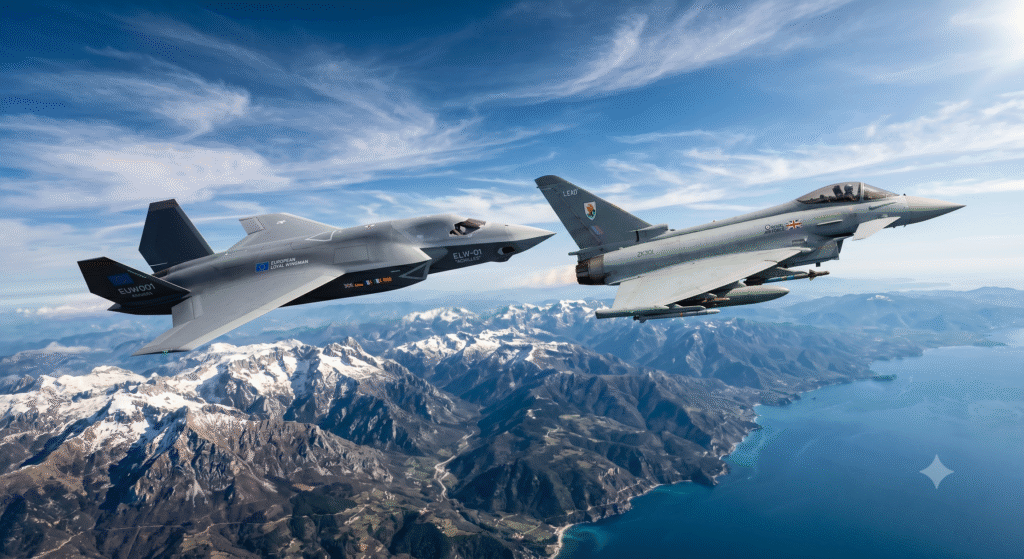
Europe’s defence rearmament is increasingly being defined not by tanks or troop deployments, but by a quieter revolution taking place in the skies above the continent. At this year’s Berlin Air Show, attention shifted toward a new generation of autonomous combat systems known as collaborative combat aircraft, or “wingman” drones, designed to operate alongside traditional fighter jets.
The concept reflects a changing understanding of modern warfare. The conflict in Ukraine has demonstrated the growing importance of drones, electronic warfare, and rapid battlefield intelligence. European defence planners have taken note, accelerating efforts to develop systems that can enhance the effectiveness of crewed aircraft while reducing operational risk.
Unlike conventional unmanned aircraft, wingman systems are not intended to replace fighter pilots. Instead, they are designed to support them. These aircraft can carry additional sensors, electronic warfare equipment, communications relays, or weapons while accompanying manned platforms into contested environments. By distributing tasks across multiple aircraft, air forces can improve situational awareness, increase survivability, and extend operational reach.
Several European companies are now competing to shape this emerging market. Aerospace giant Airbus, defence technology firm Helsing, and a growing network of specialist manufacturers are investing heavily in autonomous aviation technologies. Beyond the aircraft themselves, much of the competition centres on software, artificial intelligence, and data fusion systems that allow human pilots and autonomous platforms to operate as a single team.
The strategic significance extends beyond military capability. For decades, European governments have sought greater defence autonomy while remaining heavily reliant on American technologies. Recent geopolitical uncertainty has strengthened arguments for developing sovereign capabilities across key sectors. Wingman aircraft offer an opportunity to build expertise in areas such as artificial intelligence, cybersecurity, advanced manufacturing, and mission software while strengthening Europe’s defence industrial base.
The economic impact could be equally important. As defence budgets increase across the continent, governments increasingly view military investment as a driver of innovation, industrial resilience, and high-skilled employment. Autonomous aviation sits at the intersection of several technologies expected to shape future economic competitiveness.
Questions surrounding the use of artificial intelligence in military systems remain a topic of debate. However, the platforms currently under development are designed to operate under human supervision, with pilots and commanders retaining decision-making authority over critical actions.
Wingman aircraft are unlikely to enter widespread service until the late 2020s and early 2030s. Yet their emergence already signals a broader shift in European defence thinking. More than just a new aircraft category, they represent a continent seeking to strengthen its technological independence and adapt to the realities of modern warfare.
In many ways, the future of European air power may not be defined by a single fighter jet, but by the autonomous teammates flying alongside it.