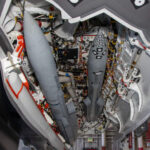
A critical milestone in future air combat capability has been reached as defense giants MBDA and Lockheed Martin successfully completed ground integration tests for the Meteor beyond visual range air-to-air missile (BVRAAM) on the F-35 Lightning II stealth fighter. The successful “fit check” represents a significant step forward in the complex engineering challenge of arming the world’s most advanced fighter jet with one of the world’s most potent air-to-air weapons.
The recent trials involved physically fitting the Meteor missile into the internal weapons bays of the F-35. This procedure is vital to ensure the weapon is physically compatible with the aircraft’s constraints and its internal launch mechanisms. Unlike older aircraft that primarily carry weapons on external wing pylons, the F-35 is designed to carry munitions internally to maintain its stealth profile and low radar cross-section.
Ensuring the long-range Meteor fits snugly within the bay while still allowing the bay doors to cycle correctly is an essential prerequisite before flight trials can commence. The integration effort is a complex collaboration involving Lockheed Martin and BAE Systems, which plays a leading role in the integration of weapons for UK variants of the jet.
A Game-Changing Combination
The combination of the F-35’s sensor suite and stealth with the Meteor missile’s range is highly anticipated by defense planners, particularly in the UK and Europe.
The MBDA-built Meteor is widely considered a game-changer in modern aerial warfare. Unlike conventional air-to-air missiles that rely solely on a solid-rocket motor that burns out quickly, Meteor utilizes a ramjet propulsion system. This allows the missile to throttle its engine during cruise and accelerate again in the terminal phase of engagement.
This unique propulsion gives Meteor a massive “no-escape zone”—the volume of space where an opposing aircraft cannot outrun or outmaneuver the incoming missile—at ranges far exceeding current competitors like the American AMRAAM.
By carrying this weapon internally, an F-35 could theoretically detect airborne threats at long distances using its advanced sensors and engage them with Meteor without ever revealing its own position to enemy radar.
Next Steps
Following the successful ground fit checks, the program is expected to move toward environmental data gathering flight trials, followed ultimately by live firing tests.
While the US Air Force primarily relies on advanced versions of the AMRAAM, the integration of Meteor is a top priority for international F-35 partners, most notably the United Kingdom and Italy. The UK Ministry of Defence has long planned for Meteor to be the primary long-range air-to-air weapon for its fleet of F-35Bs.
This successful ground test signals that the formidable combination of fifth-generation stealth and next-generation long-range lethality is one step closer to frontline reality.
Latest News
- Understanding the Footprint of London Aviation: From Local Noise to Global Climate

- Northrop Grumman ‘Project Talon’: The Autonomous Fighter
- EASA Certifies TAM’s Saab 2000 Freighter Conversion

- Baykar Expands Global Defense Footprint with Planned Drone Production Facility in Pakistan

- F-35 Stealth Fighter Moves Closer to Carrying Meteor Missiles After Successful Ground Tests