
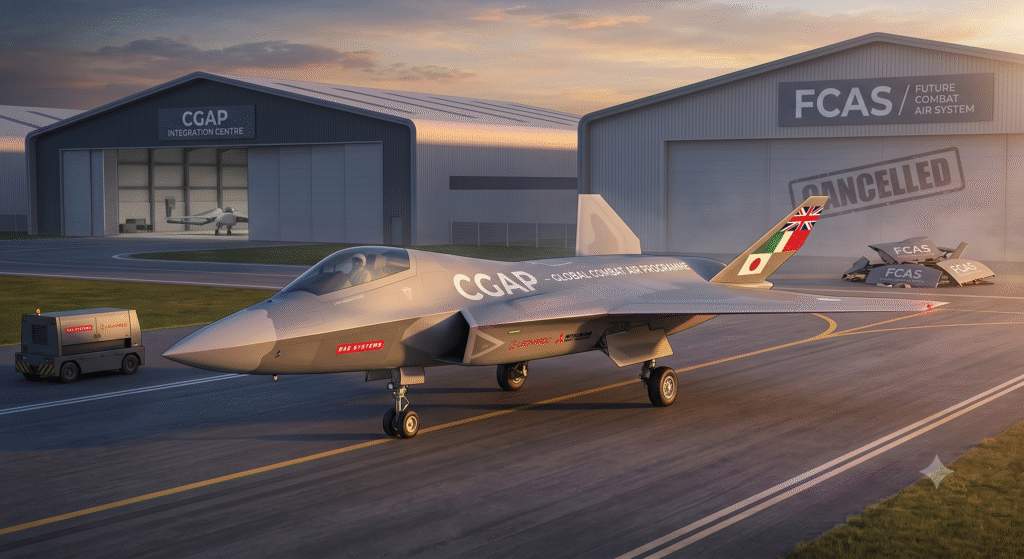
The dream of a unified, continental European fighter jet officially died in June 2026. After years of being on life support, the Future Combat Air System (FCAS), the €100 billion joint venture between France, Germany, and Spain, collapsed under the weight of irreconcilable doctrinal differences and fierce industrial rivalries. With Paris and Berlin going their separate ways on the core fighter element, a massive vacuum has opened in European defence. Filling that void is the Global Combat Air Programme (GCAP), the joint endeavour between the UK, Italy, and Japan.
Despite initial scepticism from some continental observers, GCAP is now uniquely positioned to become the de facto future of European air superiority.
The Anatomy of the FCAS Failure:
To understand why GCAP is taking the lead, it is essential to look at why FCAS stalled out before a single prototype could take to the skies.
- Divergent Strategic Needs: The partnership was plagued by fundamentally opposing operational requirements. France required a carrier capable aircraft that could integrate its sovereign nuclear deterrent. Germany, on the other hand, needed a land based interceptor capable of carrying US nuclear weapons as part of NATO’s nuclear sharing agreement.
- Industrial Friction: The corporate marriage between France’s Dassault Aviation and Germany’s Airbus Defence and Space was deeply dysfunctional. Disputes over intellectual property, design leadership, and workshare allocations led to a perpetual stalemate.
- The Limits of Political Will: At its core, the project lacked the shared strategic vision necessary to pool sovereignty. Ultimately, national interests and the protection of domestic industries trumped pan-European integration.
Why GCAP is the Path Forward:
With the Franco-German partnership fractured, GCAP has emerged not just as an alternative, but as the most viable path forward for a next-generation European fighter.
1. A Pragmatic Partnership Model:
Unlike FCAS, which was bogged down by competing national champion mentalities, GCAP was built on a clearer distribution of labour. BAE Systems (UK), Leonardo (Italy), and Mitsubishi Heavy Industries (Japan) established a more flexible governance structure early on. They prioritised engineering pragmatism over political point-scoring, allowing work on the physical jet and its underlying systems to progress steadily.
2. The UK’s Continued Indispensability:
The success of GCAP underscores a geopolitical reality that Brexit could not erase: the United Kingdom remains a cornerstone of European security. By spearheading a programme that is actually delivering on its developmental milestones, the UK has reasserted its leadership in European defence industrial strategy.
3. The Magnet for ‘Stranded’ Nations:
The dissolution of FCAS has left nations like Germany and Spain in a precarious position. They face a looming capability gap as their Eurofighter Typhoons and F/A-18s age out. While Germany has mulled going it alone or partnering with Sweden, the immense cost of developing a sixth-generation fighter makes joining an existing, functional programme highly attractive. GCAP is perfectly positioned to absorb these orphaned European partners, provided they can agree to the established frameworks and do not bring the industrial gridlock that doomed FCAS.
The New European Defence Landscape:
The collapse of FCAS is a bitter pill for proponents of European Union strategic autonomy, but it might paradoxically lead to a more capable overall European defence posture.
Rather than duplicating efforts and spreading resources thin across competing sixth-generation programmes, Europe is now facing forced consolidation. GCAP offers a pragmatic, NATO-aligned platform that brings in vital technological and financial investment from Japan, helping to shoulder the astronomical costs of development.
It’s also important to mention the partnership of BAE systems and Rolls Royce with Turk Aerospace industry which already has a flying prototype of their own 5th gen aircraft. This partnership is only bound to grow further after the historic Eurofighter Typhoon deal between UK and Türkiye.
While France will likely pivot to developing a highly advanced, sovereign successor to the Rafale to protect its independent nuclear capabilities, the rest of Europe now has a clear focal point. GCAP is no longer just a British-Italian-Japanese project; it has become the most realistic avenue for Europe to maintain a credible, cutting edge air deterrent in an increasingly unstable world. The failure of FCAS was a painful lesson in the limits of political ambition, but it has cleared the runway for GCAP to secure the future of Europe’s skies.