
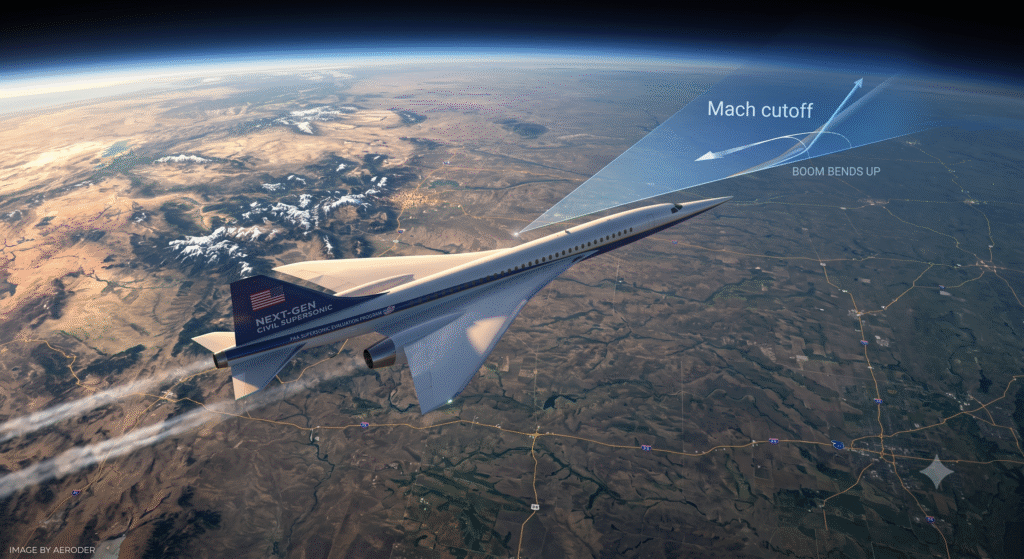
In a move set to revolutionize global travel, the U.S. Department of Transportation has announced it is moving “at lightning speed” to enable civil supersonic flight over the continental United States. The landmark decision, detailed in a newly proposed rule by the Federal Aviation Administration (FAA), outlines the first noise-based certification standards for a new generation of aircraft capable of flying faster than the speed of sound without the infamous sonic boom.
For over 50 years, federal regulations derived from 1970s noise concerns have effectively banned supersonic flight over land. However, breakthroughs in aerospace engineering, materials science, and noise reduction—specifically a technique called “Mach cutoff” where atmospheric conditions are leveraged to bend sonic booms back into the atmosphere—have made quiet supersonic flight a reality.
The announcement was made by U.S. Transportation Secretary Sean P. Duffy, marking a major policy shift. “Restoring supersonic flight over land isn’t just about speed, it’s about unleashing American innovation and ushering in a Golden Age of Travel,” Secretary Duffy stated. “Thanks to President Trump’s leadership, we are working to safely enable the next quantum leap in aviation technology and deliver an exciting new way to fly.”
Setting the Standards for Silence
The FAA’s proposed rule is the first of two crucial regulatory steps. This initial standard will establish the specific noise limits that next-gen supersonic planes must meet during cruise flight, focusing on eliminating the disruptive boom. Later this year, the FAA will propose a second rule setting noise standards for landing and takeoff, ensuring communities near airports are also protected from excessive noise impacts.
“Advances… will eliminate the old sonic boom,” said FAA Administrator Bryan Bedford. “This means we can ultimately repeal the ban from the 1970s on supersonic flight over U.S. territory while minimizing noise impacts.”
Together, these rules provide the clear regulatory guidance that aerospace manufacturers have long awaited to finalize their quiet supersonic aircraft designs. These new planes are expected to fly at speeds above Mach 1, or roughly 770+ miles per hour, drastically cutting typical travel times for both people and cargo compared to current commercial airliners, which typically cruise at 550 to 600 mph.
Regaining the Lead in Innovation
The policy shift is also framed as a strategic victory for American technological leadership. Michael Kratsios, Assistant to the President for Science and Technology, emphasized that “America wins by moving at the speed of our innovators.”
“Under President Trump’s leadership, we are clearing the runway for supersonic flight, strengthening our industrial base, creating high-skilled jobs, and ensuring the future of aviation is invented and built in America,” Kratsios said. “American ingenuity broke the sound barrier once before, and today’s action ensures it will define the new Golden Age of Aviation.”
The Roadmap to Mach 1
The FAA aims to finalize both noise standards by mid-2027. This ambitious timeline underscores the urgency and priority placed on bringing these innovations to market.
In addition to developing domestic rules, the FAA is collaborating closely with international partners, including the International Civil Aviation Organization (ICAO), NASA, and industry experts. President Trump’s Executive Order 14304, “Leading the World in Supersonic Flight,” further directs the FAA to secure agreements with foreign authorities to facilitate safe international supersonic operations, cementing the U.S.’s role at the forefront of the new supersonic era.