
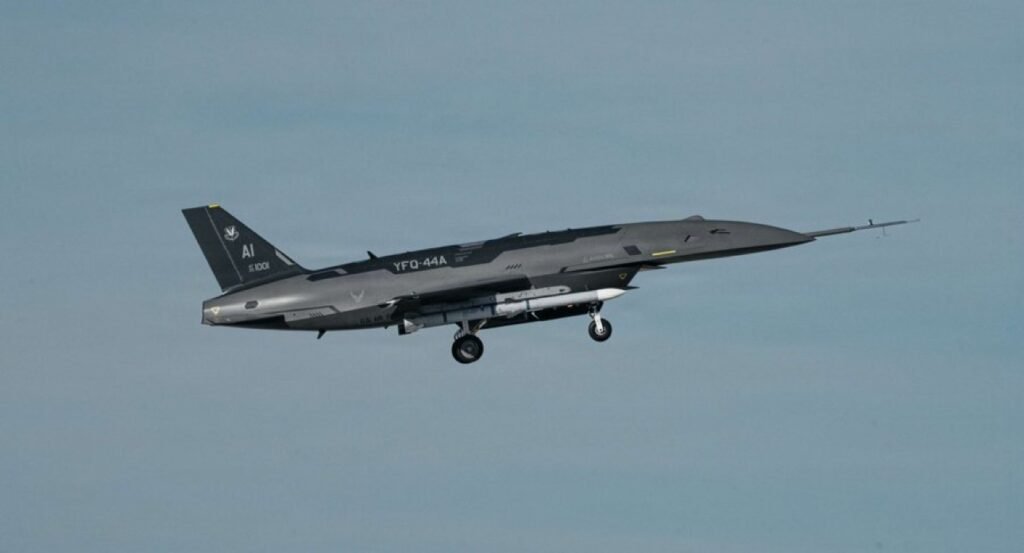
The United States Air Force has officially advanced its next-generation air combat strategy, awarding highly anticipated engineering and manufacturing development (EMD) and production contracts for the Collaborative Combat Aircraft (CCA) Increment 1 programme. The historic decision sees veteran aerospace manufacturer General Atomics and defence technology disruptor Anduril Industries selected to build the autonomous fleet of the future.
The selected platforms have now received their official military designations: General Atomics will produce the FQ-42, while Anduril will deliver the FQ-44.
While General Atomics’ selection reinforces its long-standing dominance in the uncrewed aerial systems (UAS) sector, the inclusion of Anduril represents a monumental shift in the defence industrial base. By securing the FQ-44 contract, Anduril has become the first new company to be awarded a fighter aircraft contract by the U.S. Department of Defense in 50 years.
The Significance of Anduril’s Victory
For decades, the production of U.S. fighter aircraft has been the exclusive domain of a shrinking pool of legacy ‘primes’—namely Lockheed Martin, Boeing, and Northrop Grumman. Anduril’s successful bid shatters this monopoly.
Founded in 2017, Anduril operates on a Silicon Valley ethos, prioritising rapid software iteration, venture-backed agility, and modular hardware. Their victory is a clear signal from the Pentagon: the Air Force is willing to bypass traditional aerospace giants in favour of agile, software-first companies capable of delivering ‘affordable mass’ on highly compressed timelines.
What is the CCA Programme?
The Collaborative Combat Aircraft programme is the cornerstone of the Air Force’s future tactical aviation strategy, designed to operate alongside the Next-Generation Air Dominance (NGAD) platform and the F-35 Lightning II.
Rather than relying solely on exquisite, multi-million-dollar crewed fighters, the CCA initiative aims to field thousands of autonomous, uncrewed jets. These ‘loyal wingmen’ will be commanded by pilots in crewed aircraft, executing a variety of dangerous missions:
- Offensive Strike: Carrying kinetic payloads deep into highly contested airspace.
- Electronic Warfare (EW): Jamming enemy radar and air defence systems.
- Sensor Expansion: Flying ahead of crewed fighters to provide early warning and targeting data, keeping the human pilot out of the immediate threat ring.
- Decoy Operations: Absorbing enemy surface-to-air missiles to deplete hostile magazines.
The Winning Platforms: FQ-42 and FQ-44
Both General Atomics and Anduril have taken distinct but highly effective approaches to the CCA requirement.
General Atomics (FQ-42)
Building on decades of experience with the MQ-1 Predator and MQ-9 Reaper, General Atomics brings mature manufacturing capabilities to the table. The FQ-42 is expected to draw heavily from their ‘Gambit’ series concept—a modular family of aircraft built around a common core chassis. This approach drastically reduces manufacturing costs and allows for rapid swapping of sensors, engines, and payloads depending on the mission requirement.
Anduril (FQ-44)
Anduril’s FQ-44 is heavily based on their ‘Fury’ autonomous air vehicle. Originally developed by Blue Force Technologies (which Anduril acquired), the platform is designed for high-subsonic speeds and high-G manoeuvrability. The true differentiator for the FQ-44, however, is its brain. The aircraft is powered by Anduril’s Lattice OS, an advanced, AI-driven software architecture designed to process vast amounts of sensor data and execute complex tactical behaviours autonomously, with minimal human oversight.
A Paradigm Shift in Air Combat
The CCA Increment 1 contract award is more than just a procurement milestone; it is the dawn of a new tactical and industrial era. By demanding systems that cost a fraction of an F-35, the Air Force is pivoting towards a strategy where the loss of an aircraft in combat is tactically acceptable rather than strategically devastating.
Furthermore, by elevating a young tech firm like Anduril to the status of a prime aircraft contractor, the Pentagon has fired a warning shot across the defence industry. To win future contracts, legacy aerospace companies will need to prove they can match the speed, software integration, and cost-efficiency of the new commercial tech sector.